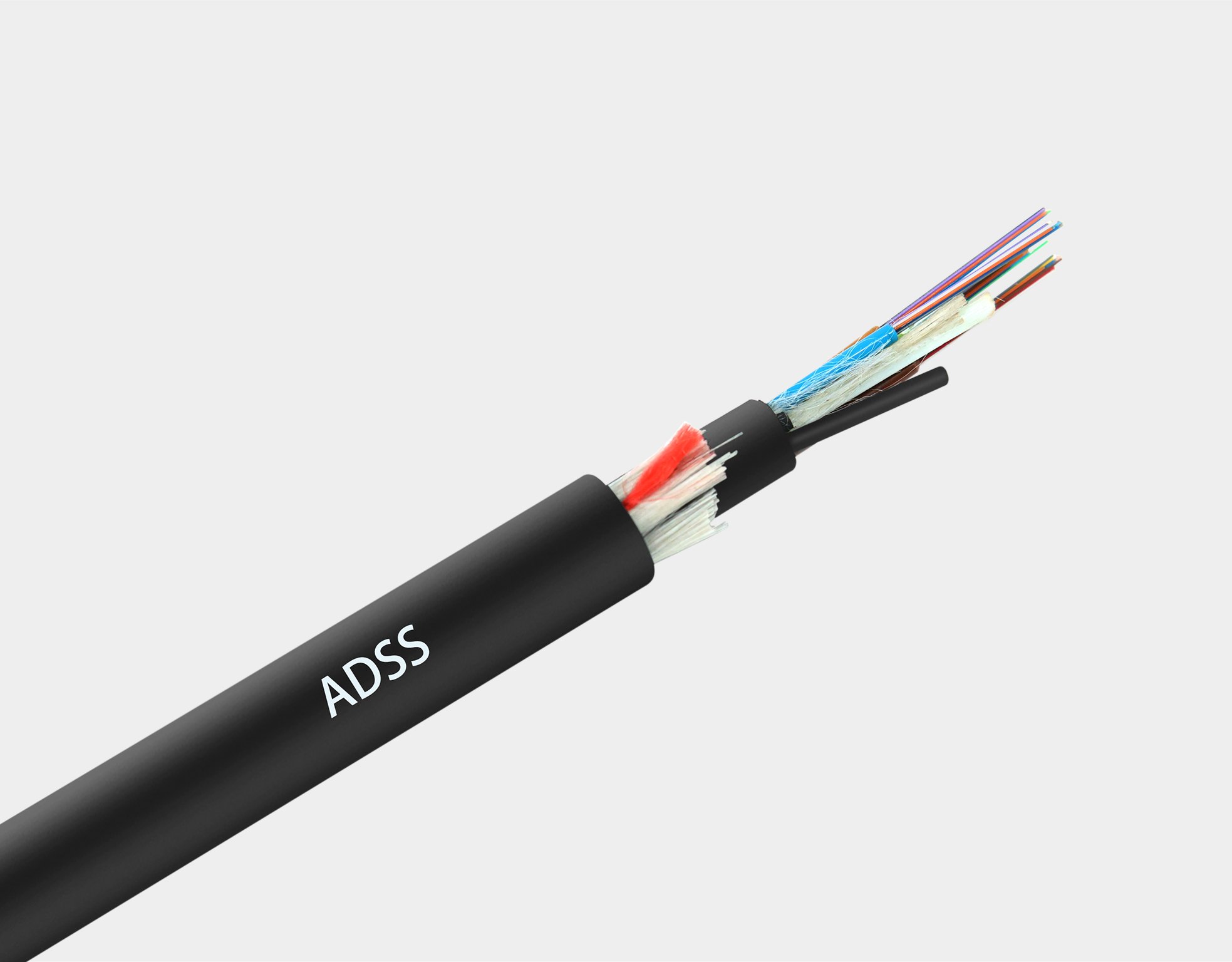
What Is ADSS Cable? Core Structure & Working Principle
Main Application Scenarios of ADSS Cable
- Power Grid Communication Network
It is the primary scenario for ADSS cable deployment. Operators lay ADSS cable along existing transmission towers to build communication channels for SCADA system, distribution automation, relay protection and substation interconnection. For old power grid renovation projects, ADSS supports live-line installation without power cut, greatly reducing economic losses caused by power outage.
- Renewable Energy Base Communication
Wind farms, photovoltaic power stations are usually built in remote mountainous or coastal zones with complex terrain. Trenching and pipe laying are extremely costly. ADSS cable spans obstacles conveniently to connect turbine monitoring equipment and centralized control room.
- Railway & Highway Traffic Communication
ADSS cable provides stable fiber links for traffic monitoring, signal control and emergency communication along transport corridors.
- Rural Broadband & 5G Base Station Backhaul
Utilizing existing power pole resources avoids new pole construction and land negotiation, lowering FTTx and base station fiber access investment in rural areas.
- Cross-obstacle Special Engineering
Crossing rivers, canyons, wetlands and protected farmland where pole erection is restricted. ADSS large-span design avoids massive civil construction.
Core Pain Points Users Meet in ADSS Cable Projects & Root Causes
Pain Point 1: Cable sheath electric corrosion, short service life under high-voltage corridors
Many buyers purchase low-cost PE jacket ADSS cable and deploy it alongside 110kV transmission lines. Under long-term high-voltage induction electric field, partial discharge occurs on cable surface, forming tracking marks, gradually penetrating the jacket and damaging fiber tubes.
Solution: Confirm the voltage level of parallel power lines before ordering. All routes above 35kV with high field strength must select AT anti-tracking jacket ADSS. Engineers also need to calculate tower hanging position reasonably to avoid areas with concentrated electric field intensity.
Pain Point 2: Cable fracture or excessive fiber attenuation after wind vibration
Long-span ADSS cable suffers aeolian vibration under continuous wind load. Without vibration dampers, repeated vibration triggers fatigue damage of aramid yarn and micro-bending loss of optical fiber. Many contractors ignore supporting accessories and only purchase cables, leading to hidden risks.
Solution: For spans over 300 meters, configure anti-vibration dampers and spiral vibration control fittings. Design reasonable tension and sag strictly according to meteorological conditions (wind speed, ice thickness). Avoid over-tension during cable pulling.
Pain Point 3: Wrong span specification selection, cable cannot withstand ice and wind load
A common mistake: users only focus on fiber count while ignoring rated span parameters. An ADSS cable designed for 100-meter span cannot be used for 400-meter crossing. Under ice coverage or typhoon weather, tensile load exceeds the limit of aramid yarn, causing cable breakage.
Solution: Provide project meteorological data (ice zone grade, maximum wind speed) and actual span distance to manufacturers. Suppliers configure corresponding aramid yarn dosage to match mechanical performance requirements.
Pain Point 4: Poor compatibility between cable and suspension tension fittings
Procurement teams buy cables and hardware from separate vendors without verification. Clamps mismatch cable outer diameter, resulting in sheath extrusion abrasion, slipping at tension points. In severe cases, the cable falls off the tower.
Solution: Source matched fittings together with ADSS cable. Professional manufacturers provide complete sets of suspension clamps, tension clamps, armor rods and connecting hardware.
Pain Point 5: High total project cost, confused between ADSS Cable and OPGW
Project owners struggle to choose between ADSS and OPGW. OPGW is integrated into ground wire for new transmission lines, but extremely expensive for old line reconstruction. Replacing original ground wire requires power cut and large-scale tower reinforcement.
Solution Judgment Matrix:
- New transmission line construction: prioritize OPGW;
- Existing power tower renovation, live-line construction demand: choose ADSS Cable;
- Budget limited, no requirement for ground wire function: ADSS delivers significantly lower TCO.
Pain Point 6: Coastal, humid industrial areas suffer accelerated jacket aging
Salt fog, acid gas in coastal and chemical zones erode ordinary HDPE sheath. Low-grade outer jacket material cracks after several years of UV exposure.
Solution: Select UV-stabilized enhanced AT jacket, add anti-aging formulation for coastal projects; avoid low-price cables using recycled plastic sheath.
Pain Point 7: Construction damage during pulling, hidden faults difficult to detect
Unregulated pulling causes cable twisting, excessive side pressure, minimum bending radius violation. Damage cannot be found visually, leading to random fiber signal interruption after several months of operation.
Solution: Control dynamic bending radius ≥20 times cable outer diameter during installation; adopt tension laying method; use OTDR test before shipment and after installation to record baseline data for maintenance.
Key Standards to Select Qualified ADSS Cable
- Fiber Type: Confirm single mode G652D or G657A2 according to transmission distance; fiber count ranges from 4 cores to 144 cores for flexible selection.
- Jacket Standard: Distinguish PE / AT anti-tracking jacket strictly based on parallel power voltage.
- Mechanical Parameter: Rated tensile strength, allowable installation tension, ultimate tension matching project span and meteorological load.
- Water Blocking Performance: Full water-blocking design with water-blocking yarn, water-blocking tape and filled grease to prevent water ingress causing fiber attenuation increase.
- Certification: Products comply with IEC 60794, relevant utility industry standards, available test reports for anti-tracking, tensile, low-temperature impact.
- Packing & Drum Length: Custom drum length according to route layout to reduce field splicing points; export orders adopt seaworthy wooden cable drums with moisture protection.
ADSS Cable Installation Best Practices to Reduce Operation Failure
- Confirm safe distance between ADSS cable and live power conductors during live-line working, operate under wind speed below Grade 5.
- Calculate sag precisely. The sag of ADSS cable should be reasonably set to prevent collision with power lines under strong wind swing.
- Reduce mid-span splicing as much as possible. Complete splicing points are arranged on tension towers rather than suspended mid-air.
- Lay protective armor rods at positions contacted with clamps to prevent sheath abrasion.
- Reserve enough cable length at both ends of each span for later maintenance and re-splicing.
- Complete OTDR testing after installation, archive test curves for future fault troubleshooting.